
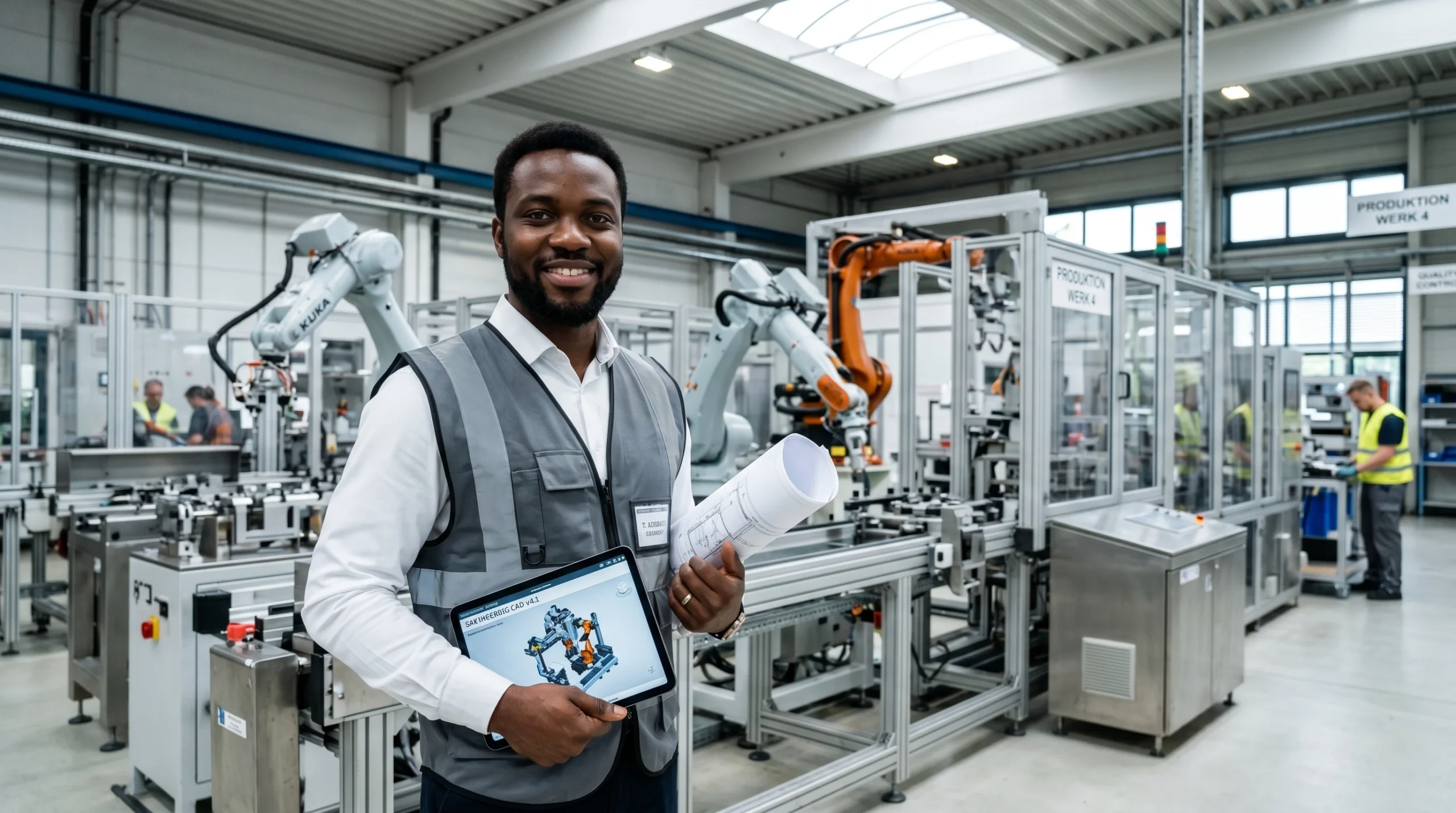
Germany is the fourth-largest economy in the world, and it has a serious problem: not enough engineers. From mechanical and electrical engineering to civil infrastructure and software development, German companies are reaching into Africa — including Nigeria — to fill critical skills gaps.
If you hold an engineering, IT, or technical degree from a Nigerian university and have at least two years of work experience, you may qualify for Germany’s EU Blue Card — a fast-track work and residence permit that comes with one of the clearest pathways to European permanent residency available today.
Salaries for engineers in Germany start at €45,000 per year for junior roles and reach €75,000 or more for senior positions. Let us break down exactly how to get there.
Overview of the Opportunity
Germany introduced the EU Blue Card as a tool to attract high-skilled workers from outside the European Union. The card is specifically designed for people with recognised university degrees who have a job offer paying above a set threshold (currently €43,800/year for most roles and €34,000/year for shortage occupations including engineering and IT).
Germany is not merely tolerating skilled foreign workers — it is actively passing new immigration laws (the Skilled Immigration Act of 2024) to make the process faster and more accessible for people coming from Nigeria and other non-EU countries.
Why This Opportunity Matters
An engineering graduate in Nigeria may earn between ₦200,000 and ₦700,000 per month depending on sector and employer. In Germany, an entry-level engineer earns approximately €3,500–€4,500 per month — which translates to roughly ₦5.6 million to ₦7.2 million at current exchange rates.
Germany also offers something that is hard to put a number on: stability. Free or heavily subsidised university education (you can enroll in free German university programs for your children), a world-class public healthcare system, and one of the safest countries in Europe to raise a family.
How the Program Works
You secure a job offer from a German employer. Your Nigerian engineering degree is assessed for equivalency through anabin (the German university degree recognition database) or through ENIC-NARIC. Once your qualification is recognised and you have a valid job offer, you apply for the EU Blue Card at the German consulate or embassy in Abuja or Lagos.
The Blue Card is issued for 4 years (or the duration of your contract plus 3 months, whichever is shorter). After 21 months (or 33 months if you do not yet speak B1 German), you can apply for permanent residency.
Key Employers and Sponsors
Germany has more than 55,000 engineering job vacancies at any given time. Key employers actively hiring internationally include:
- Siemens — automation, energy, infrastructure
- Bosch — engineering and manufacturing
- BASF — chemical and process engineering
- Volkswagen / BMW / Mercedes-Benz — automotive engineering
- SAP — software engineering and ERP development
- Daimler Truck — mechanical and production engineering
- Hundreds of German Mittelstand (mid-size) companies in machinery, industrial, and energy sectors
Eligibility Requirements
- A university degree in engineering, IT, science, mathematics, or a related technical field
- Degree must be recognised or assessable in Germany (most Nigerian university degrees from accredited institutions qualify)
- A formal job offer from a German employer meeting the Blue Card salary threshold
- Basic German language skills are helpful but not mandatory at the visa stage (many German companies conduct work in English)
- Valid Nigerian passport
- No serious criminal record
Required Documents
- Recognised or certified university degree (with translation into German)
- Official transcripts
- German job offer / employment contract
- Updated professional CV (Europass format recommended)
- Valid international passport
- Proof of health insurance (German statutory or private)
- Proof of accommodation in Germany (provided by employer in many cases)
- Passport photographs
Step-by-Step Application Process
Step 1: Go to anabin.kmk.org and search for your Nigerian university. Check whether your qualification is listed as H+ (directly recognised) or requires further assessment.
Step 2: Search for engineering jobs in Germany on platforms like Make it in Germany (make-it-in-germany.com), StepStone.de, LinkedIn, or Xing.
Step 3: Apply with a strong CV and cover letter. Tailor your application to the German job market — Germans value precision, qualifications, and structured career histories.
Step 4: After a job offer, sign your employment contract and gather all required documents.
Step 5: Book an appointment at the German Consulate in Lagos (Germanembassy.org.ng) to apply for your EU Blue Card.
Step 6: After approval (typically 4–12 weeks), collect your visa, travel to Germany, and register your address at the local Einwohnermeldeamt (registration office) within 14 days of arrival.
Step 7: Your EU Blue Card will be issued by the local Foreigners’ Office (Ausländerbehörde) in Germany.
Important Deadlines
Germany’s EU Blue Card has no annual quota or deadline. Applications are accepted year-round. However, German consulate appointments in Lagos book up quickly — schedule your appointment as soon as you have your job offer.
Types of Engineering Roles Available
- Mechanical Engineer
- Electrical / Electronics Engineer
- Civil / Structural Engineer
- Process / Chemical Engineer
- Software Engineer / Developer
- Automotive Engineer
- Industrial / Manufacturing Engineer
- Environmental / Energy Engineer
💰 Salary and Financial Breakdown
| Role | Annual Salary (EUR) | Monthly (EUR) | Monthly Naira Equivalent |
|---|---|---|---|
| Junior Engineer | €42,000–€50,000 | €3,500–€4,170 | ₦5,600,000–₦6,670,000 |
| Mid-Level Engineer | €52,000–€65,000 | €4,330–€5,420 | ₦6,930,000–₦8,670,000 |
| Senior Engineer | €68,000–€85,000 | €5,660–€7,080 | ₦9,060,000–₦11,330,000 |
| Engineering Manager | €90,000–€120,000 | €7,500–€10,000 | ₦12,000,000–₦16,000,000 |
Germany has high income taxes (25–42%), but workers also benefit from free public healthcare, pension contributions, unemployment insurance, and other social protections worth thousands of euros annually.
Additional Benefits
- Free public healthcare (statutory health insurance)
- Pension contributions from employer (approx. 9.3% of gross salary)
- 24–30 days paid annual leave (legally mandated minimum is 20 days)
- Generous parental leave (up to 14 months at 65% salary)
- Free or low-cost university education for your children
- Pathway to German permanent residency in 21–33 months
- Pathway to German (and EU) citizenship after 5–8 years
Common Mistakes to Avoid
- Applying without degree recognition — check anabin first. Do not assume your Nigerian degree automatically qualifies.
- Ignoring German language — even if not required, learning German to B1 level cuts your wait for permanent residency from 33 to 21 months. Worth the effort.
- Only targeting big cities (Munich, Berlin, Hamburg) — cities like Stuttgart, Nuremberg, and Dusseldorf have strong engineering demand and lower cost of living.
- Not formatting your CV for the German market — German employers expect a detailed, structured CV with a professional photo, precise dates, and no unexplained gaps.
Conclusion
Germany is one of the best countries in the world for skilled engineers — and it wants workers from Nigeria. With EU Blue Card salaries of €45,000–€75,000, permanent residency in under 2 years, and free healthcare for you and your family, this is an opportunity that belongs at the top of your list. Start with your degree recognition check today.
→ Visit make-it-in-germany.com to explore current engineering job openings and the Blue Card application process
Frequently Asked Questions
1. Do Nigerian engineering degrees qualify for the German EU Blue Card? Many do, particularly degrees from COREN-accredited or internationally recognised Nigerian universities. Check anabin.kmk.org for your specific institution.
2. Do I need to speak German to get a job in Germany? Not necessarily. Many German companies — especially in engineering and tech — operate partly or fully in English. However, learning German significantly improves your employment prospects and daily life.
3. How long does the EU Blue Card visa process take? From job offer to arrival in Germany typically takes 3–5 months, including degree recognition (4–8 weeks) and visa processing (4–12 weeks).
4. Can my spouse work in Germany with me? Yes. Spouses of EU Blue Card holders receive an unrestricted work permit, meaning they can take any job in Germany without restriction.
5. What happens after the EU Blue Card? Can I stay permanently? Yes. After 21 months of employment and B1 German, or 33 months without B1, you can apply for a German Settlement Permit (permanent residency). German citizenship is available after 5 years.
Apply here:
- Make it in Germany (official government portal): https://www.make-it-in-germany.com
- Degree recognition check (anabin): https://anabin.kmk.org
- EU Blue Card official info: https://www.make-it-in-germany.com/en/visa-residence/types/eu-blue-card
- German Consulate Lagos appointments: https://lagos.diplo.de